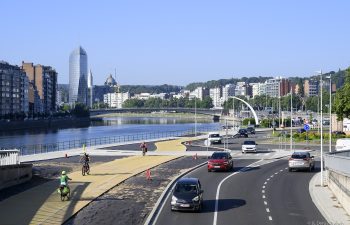
This Saturday, May 10, the tram celebration will take place in Liège. It’s an opportunity to look back on this large-scale project in which the greisch office was involved as a partner from the design phase.
An Initial Study Phase
Initiated more than 10 years ago, the project to bring the tram back to Liège is a public-private partnership. In this context, the contracting authority, OTW (Wallonia Transport Operator), entrusted a project design mission to the consortium of engineering firms, Liège Tram, with the Greisch office acting as lead partner. The mission includes a study phase, up to obtaining the full urban planning permit, which defines all aspects of the future development. To delegate the execution of the works, their maintenance, and financing to a service provider – in this case, Tram’Ardent – Liège Tram drafted a requirements specification describing the needs along the entire 12 km route of the future tram line.
Coordination as Core Expertise
In this project, bureau greisch acted as both expert and coordinator on several levels. Given the scale of the operation, numerous specific areas of expertise were required. Their coordination proved essential to ensure the overall efficiency of the intervention.
The multidisciplinary nature of bureau greisch fostered cohesion within the Liège Tram consortium. Its various departments were mobilised at every stage of the project. The Civil Engineering department worked on infrastructure developments along the entire route, as part of a complete façade-to-façade urban redesign.
The Structures department was responsible for reviewing the studies conducted by the contractor on the bridges along the 12 km line. Widening the Atlas Bridge — necessary to accommodate a dedicated tramway and a bike path — was the most complex and emblematic operation of the entire project. The Modeleurs and Tilleuls bridges required the relocation of piers to allow coexistence of traffic lanes and tramway. A new access ramp to the Modeleurs Bridge was also designed using reinforced earth embankments.
The design of the technical buildings — the tram depot and maintenance centre, two park-and-ride facilities (P+R), the Tramwash, substations, and driver facilities — as well as the drafting of the related construction requirements, were carried out by the architectural firm Canevas, part of bureau greisch.
The Building Services Engineering department worked across all the buildings, and also took part in supervising specific operations, such as relocating the ventilation systems in the Saint-Lambert parking facility.
Beyond its coordination duties — including coordination with institutional partners such as the City of Liège or SPW — bureau greisch also carried out quality control. This was aimed at ensuring that the solutions proposed by the contractor met all applicable standards, Qualiroutes requirements, and the project’s specification document.
Client: OTW / Walloon Region
Project author: SM LiègeTram (bureau greisch, Canevas, atelier d’architecture du Sart-Tilman, Richez firm, Transamo and STIB in partnership with Transitec engineering consultants and Semaco)
Contractor: Tram’Ardent (Colas)