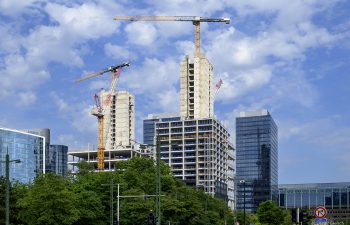
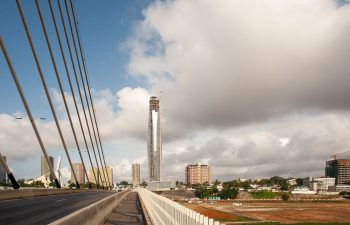
Following its collaborations on projects such as F Tower by architect Pierre Fakhoury in Abidjan and ZIN by 51N4E, Jaspers-Eyers Architects and AUC in Brussels, bureau greisch continues to work alongside internationally renowned architects on high-rise developments. In Antwerp, the firm is collaborating with architect Shigeru Ban, recipient of the Pritzker Prize, widely regarded as the Nobel Prize of architecture, on the construction of a new mixed-use complex. This project also reflects bureau greisch’s ambition to further accelerate its development in Flanders.
A new district in the south of Antwerp
The city of Antwerp continues to expand, with the Nieuw Zuid district driving the development of the southern part of the city. Located close to the city centre, the neighbourhood already includes more than 1,250 apartments and 21 residential buildings. It is characterised by its strong emphasis on sustainable mobility, generous green spaces and its close relationship with the River Scheldt.
Within this setting, BAN Antwerpen is currently under construction. The development comprises a 25-storey high-rise tower together with several six-storey mid-rise buildings. The complex will accommodate apartments, offices and retail spaces. The buildings combine reinforced concrete structures with timber façades.
Reconnecting with nature to restore balance
Shigeru Ban describes his vision for the project as follows:
“Wood, gardens and people are the key concepts behind this project. I wanted to create a place where people can relax and reconnect with themselves. That is why I chose abundant greenery and a spacious inner garden. A green environment naturally creates a sense of calm. In Japan, we have a term for this: Shinrin-Yoku. It means restoring balance by immersing yourself in nature. […] I have also chosen to incorporate extensive timber elements, as I do in all my projects. I particularly appreciate this material, especially since its carbon footprint is significantly lower than that of steel or concrete. BAN is based on a hybrid structural system combining concrete, steel and timber, in which the timber façade elements play a defining role. This timber façade is truly my architectural signature, and I am pleased to leave my mark on Antwerp’s urban landscape in this way.”[1]
An optimised concrete structure
The structural system of the development is designed in reinforced concrete, combining precast and cast-in-place elements to optimise both structural performance and construction efficiency. The columns are made of high-strength precast concrete. They are connected to the perimeter beams, which are cast in place and integrated within the floor depth, by means of mechanical couplers embedded in the columns. Lateral stability is provided by the reinforced concrete core walls. In the high-rise tower, these walls are entirely cast in place.
The floor systems differ according to the building. In the high-rise tower, the one-way floor slabs consist of semi-precast slabs. In the mid-rise building, cast-in-place flat slabs are used. In both cases, the slabs are 24 cm thick, allowing the ventilation ducts to be integrated within the floor depth and thereby optimising the clear floor-to-floor height.
Finally, the balconies, manufactured in precast architectural concrete, are connected by thermal break elements to ensure the continuity of the building envelope insulation.
Foundations designed to withstand water pressure
Due to the site’s proximity to the River Scheldt, the project required the construction of a watertight underground enclosure, with particular attention paid to the significant hydrostatic pressure. The watertight excavation is achieved by means of a soil-mix retaining wall, complemented by an inner retaining wall.
At the central plaza, the building loads are relatively low. Consequently, the upward hydrostatic pressure exceeds the applied structural loads. To prevent uplift, tension piles (Ø 40 cm) have been installed in these areas.
The tower foundations consist of Continuous Flight Auger (CFA) piles with a diameter of 1.08 m. Owing to their high density, an additional assessment was carried out to evaluate the influence of pile group effects.
Project team
- Client: Triple Living
- Architect: Shigeru Ban Architects
- Executive Architect: Bureau Bouwtechniek
- Engineering consultants:
- Structural engineering: bureau greisch
- Building Services & Energy: Sweco Techniek
- Contractor: Van Laer
- Independent checking authority: Socotec
[1] https://www.nieuwzuid-antwerpen.be/nl/projecten/9/ban, 10/06/2026