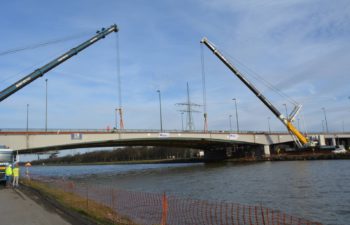
Among the major infrastructure projects in Flanders, the replacement of 42 road bridges is a key undertaking. Spread across the region, these ageing bridges must be demolished and replaced. The Vlaamse Overheid Departement Mobiliteit & Openbare Werken carried out an upstream classification of the engineering structures on its territory to determine which bridges were considered most urgent, whether due to significant deterioration or a high usage rate. Motorway overpasses or underpasses, bridges over railway lines and waterways: the locations of these structures are varied. Within this project, sixteen have been entrusted to bureau greisch, nine of which are currently under study. This group can be divided into two main categories: multi-span bridges and single-span “portal” bridges.
Diversity of Structures and Limited Impact on Traffic
The client wishes to minimise the impact of the works on road traffic. In the case of portal bridges, two configurations are possible.
When the situation allows, the structures are prefabricated on site, alongside the motorway. The new foundations are built while maintaining the existing structure. During a weekend operation, traffic on the motorway is interrupted: the existing portal structure is then demolished and replaced by the new portal structure, which is moved and positioned using self-propelled modular transporters (SPMT or Kamag). In the other case, once the preparatory works have been completed, traffic is diverted onto one half of the existing bridge, which remains in service. The other half is demolished and rebuilt. Traffic is then switched onto the new section, and the second section is replaced in the same way. The relative standardisation of these portal structures enables an efficient design process: the firm draws on the structures already studied to design the others, while adapting the solution to local geotechnical conditions, construction methods and execution constraints requested by the contractor.
The longer-span structures (> 20 m) are multi-span bridges, and full prefabrication was not selected. The bridges are therefore built on site and consist either of a fully reinforced-concrete structure (prestressed slabs) or a composite structure made up of steel box girders and a concrete deck. Structural maintenance works, such as replacement of the surfacing, will benefit from the new configurations put in place. The width of the bridge will make it possible to divert the four traffic lanes to one side, without closing lanes and without implementing long diversions.
In addition to standardisation, bureau greisch draws on the knowledge acquired from structures such as the widening of the Cheratte viaduct, the Saint-Denis footbridge in Paris, or the Lommersweiler bridge.
Integral Bridges, Durability and Technical Challenges
Another requirement of the client is to limit maintenance and maximise the durability of the new structures. With the exception of the Ingelmunster bridge, which is semi-integral because it includes bearings, the bridges are integral. The deck and columns are built monolithically, without joints or bearings. This configuration avoids the use of bearings, which are subject to greater wear. However, it generates additional forces in the columns, which must be taken into account in the studies. In addition, integral bridges are sensitive to settlements. Studies on embankment stabilisation and construction phasing are therefore required. Another aspect adds complexity to the overall design: the reduced deck thickness compared with the original bridges. Road clearances are indeed higher than at the time of the initial construction, while the final longitudinal profile of the running surface remains unchanged. For these structures, bureau greisch draws on its expertise in integral bridges, such as the “OA583” Y bridge in Gasperich or the Ampsin steel footbridge.
Specific Cases: Two Structures Over Canals
Two bridges stand out as they span the Roeselare-Leie Canal in Ingelmunster and the Nevele diversion canal. In addition to the standard studies for these structures, pier protection systems are also planned. These protect the structure against potential vessel impacts. The quay walls are also being studied. These two structures are multi-span bridges with steel box girders. A concrete deck is placed on this steel structure. Standardisation is also being sought between these two structures.
The PPP Model: Effective Public-Private Cooperation
For the “OverBruggen” programme, the Flemish Region opted for a DBFM-type public-private partnership (PPP). This is a collaboration between the public authorities and a private partner, under a single contract covering the design, construction, financing and maintenance of the infrastructure. The appointed consortium of private companies has the necessary capacities to renew, renovate or modernise all the bridges concerned.
Under a DBFM contract, the private partner finances the structure and remains responsible for its maintenance and performance for a defined period after commissioning. The public authorities then remunerate the partner through payments spread over the duration of the contract, generally in the form of an availability payment conditional on compliance with the expected performance levels. This mechanism makes it possible to spread the financial burden over time while transferring a significant share of the design, construction, financing and maintenance risks to the private partner.
The use of a DBFM contract is particularly relevant for large-scale infrastructure programmes requiring significant investment and a long-term vision of the life cycle of the structures, such as the “OverBruggen” project.
This choice offers several advantages:
- Large-scale renovation or renewal projects are easier to manage thanks to centralised responsibility.
- The Flemish authorities and private companies can pool their expertise, technical capabilities and financial resources.
- Risks are better allocated between the parties.
- Operation and maintenance costs are taken into account from the design phase, promoting an approach based on the overall life-cycle cost. The long-term quality of the structure is therefore enhanced.
- Execution of the works is more efficient and faster thanks to better coordination between the different phases of the project.
Project Stakeholders
- Client: Vlaamse Overheid Departement Mobiliteit & Openbare Werken – Afdeling Expertise Beton en Staal (EBS)
- Architect – Infrastructure: T.V. Bruggenbouwer (Arcadis-SBE) + IPV Delft
- Contractor: Brugfabriek: T.V. Jan de Nul + Willemen
- Engineering firm: Bureau greisch – Sweco