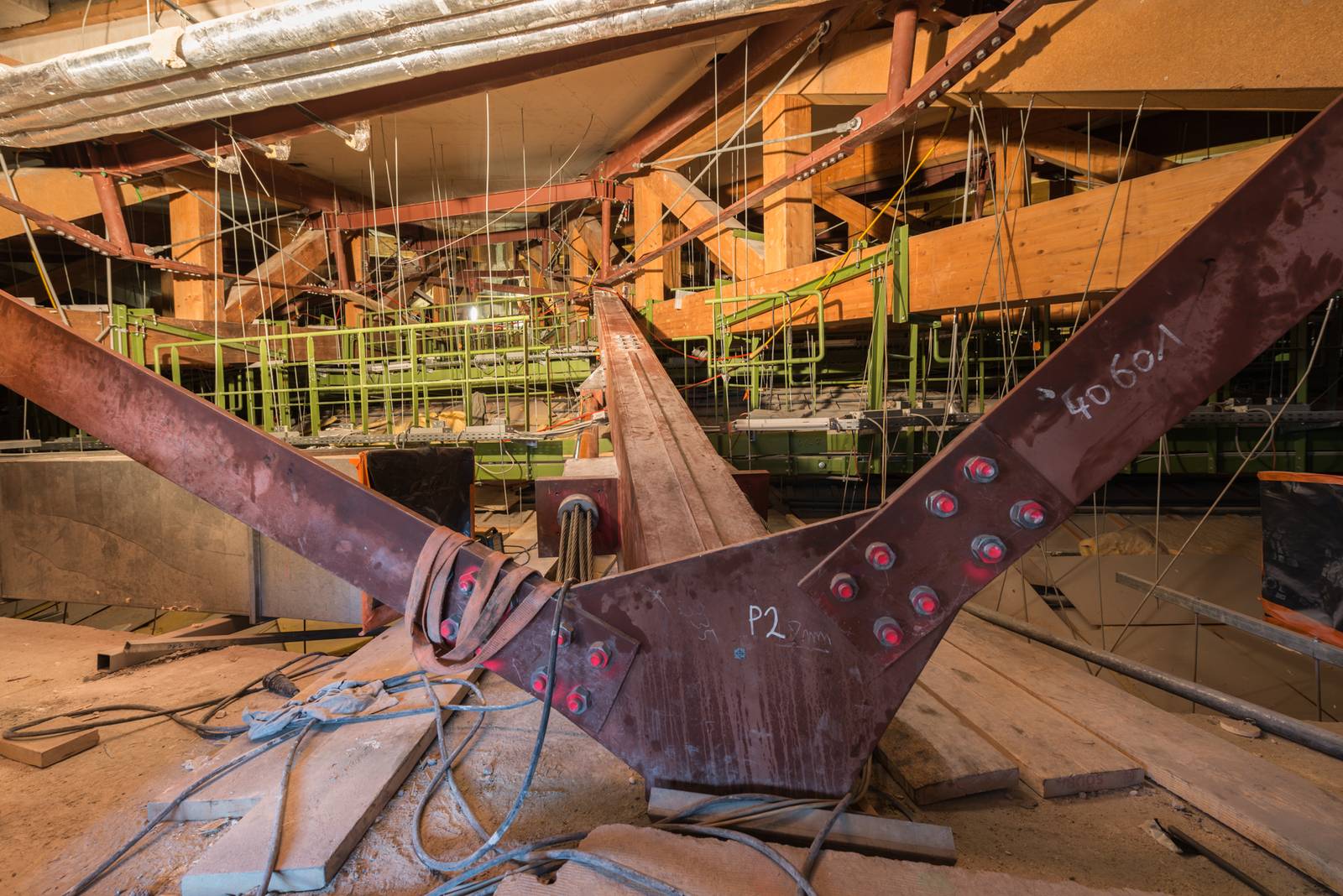
Hemicycle frame of the European parliament phamber
The existing framework is made up of twenty-one glued laminated wood truss beams, arranged radially around a steel core. A first phase of analysis of this structure (dimensions: thirty by forty meters), whose design, construction and assembly date from the nineties, made it possible to demonstrate that the origin of the cracks discovered was linked to an effect combined with aging of the wood and a high sensitivity of the existing structure to redistributions. The concept of aging was unknown at the time of the design of the frame in question.
After considering various alternatives, the solution chosen excludes the participation of wood in the structural functioning of the frame and improves the behavior of the structure by creating a quasi-isostatic reinforcement structure.
The overall philosophy of the intervention consists of the installation, inside the existing structure, of a new «isostatic» metal frame completely eliminating the contribution of wood after intervention. It is composed of a main beam subtended by prestressing with a span of thirty meters on which are supported twenty-one radial trusses, also subtended, whose geometry is defined by the distribution of the transferred loads (funicular ).
Depending on the security and mounting constraints, the entire structure is designed so that it can be implemented from the passageways of the PHS building, without dismantling the false ceiling of the hemicycle or of the roof and can be assembled without any welding (bolted or sleeved assemblies).
All the elements constituting the frame must be able to be transported by hand or via spreaders suspended from the primary frame (limitation to 1 ton).
The fixed loads of the wooden frame (300 t) were transferred to the new frame by means of flat jacks placed between the wooden trusses and the radial metal structures. The main structure is loaded without deformation by means of prestressing strands located at its lower chord.
The use of a metal frame in the center of a wooden structure required a special study of differentiated behavior in a fire situation.
The complexity of the project lies in the interaction of the two structures during the jacking phases (jacking at a hundred different points with up to 12 simultaneous lifting points) which required a complete modeling of the two frames and a detailed study of the phasing loading. In addition to the modeling problem, the difficulty linked to determining a new frame geometry inside the wooden structure was a challenge.
Mission
Complete stability mission