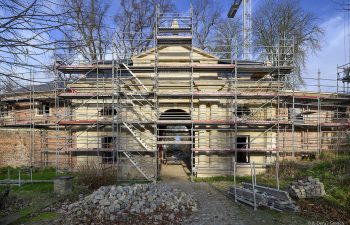
Located between Boulevard d’Avroy and Rue Saint-Gilles in Liège, the Montéfiore Institute, comprising a U-shaped main building, an amphitheatre and a street-facing house, is undergoing a major transformation. Drawing on its expertise in heritage renovation, such as the complete renovation of the Brussels Stock Exchange and Forest Abbey [add links], bureau greisch has been appointed for the stability engineering mission for this architectural complex.
Buildings steeped in history
The U-shaped main building, built in 1881, and the neo-classical auditorium, built in 1902 and housing an amphitheatre identical to Faraday’s in London, were occupied by the Electrotechnical Institute of the University’s School of Mines and, in the 1960s, by the Lambert Lombard Higher Institute of Architecture.
Designed by the Liège architect Emile Demany and subsequently altered in 1885 by the architect Paul Jaspar, the complex is arranged around an inner courtyard. Various listing notices protect some of the buildings, either in whole or in part. Left abandoned for many years, the site is now undergoing a complete redevelopment.
Respecting the existing fabric
The Montéfiore building, listed as major Walloon heritage since 1993, has a roof structure made up of metal trusses of high heritage value, which cannot be altered. The new use of the drawing room on the top floor as a meeting room requires acoustic floors, making structural reinforcements necessary to support the higher new loads. New columns and beams are therefore being installed. Thanks to these reinforcements, the building complies with current standards.
For the Amphitheatre, respecting the envelope is the starting point, while the interior is stripped out and rebuilt. To meet the new requirements, a technical room is added to this envelope, taking advantage of the existing geometry. This lightweight timber and metal structure is supported by a reinforced slab on the ground floor, onto which the loads are transferred.
Construction of new buildings
In addition to this renovation, new buildings are being constructed.
An atrium creates the connection between offices located on Boulevard d’Avroy and the Montéfiore building, above an existing underground car park. This large volume has a fully glazed façade and provides a multifunctional space on the ground floor. As the two buildings it connects do not have the same floor levels, the structure is designed to link these different levels by means of a central staircase built around a large concrete wall. The new loads are diverted down to level -4, and foundation reinforcements are carried out at this level, in the underground car park.
A conventional four-storey office building above ground level, using precast beams and floor slabs, is being built above the new car park, as well as a residential building of the same type on the other side of the courtyard.
Taking geotechnical elements into account
In addition to the buildings, a new underground car park is being constructed on the site. To create it, two characteristic features of the Meuse Valley played a key role: a groundwater table close to the surface (elevation 60 m) and bedrock at elevation 52 m.
First, the rock mass was characterised to determine its exact level, permeability and quality for the foundation design. Next, retaining walls consisting of secant piles and anchors were constructed, the soil was excavated to a depth of 10 m, and groundwater was pumped out. Following the installation of vertical micropiles, the raft foundation was cast. The micropiles anchor the raft to the bedrock and resist the hydrostatic pressure of 6 t/m². Finally, counter-walls were constructed to ensure the complete watertightness of the structure.
This redevelopment gives a second life to this remarkable complex while enhancing the architectural heritage of Liège.
The actors of the project
- Client: MONTEFIORE DEVELOPPEMENT SA
- Architect: Paul Hautecler + Valentiny Architectes
- Engineering offices
- Structural engineering: Bureau greisch
- Building services: Bureau d’études Pierre Berger
- Acoustics: ATS—Eric Bruyère
- Contractor: Moury-Denys